
Please post new comments at the bottom of this page. Click here for videos or for past discussions. You can also follow discussions connected to recent books.
Synodality
The World Synod of Bishops will meet in Rome starting October 4, 2023. This is the culmination of a process begun by Pope Francis in 2021. The topic is “synodality,” defined as how the church can go forward together. As a process that emphasizes listening, discerning, and making decisions, synodality will have consequences for pastoral councils. Councils differ from listening sessions, however, because council members have a specific office and a practical subject matter. The “listening phase” of this process has taken place locally, nationally, and at the continental level:
- The 2022 Archdiocese of Los Angeles Synod Report can be accessed at: https://synod.lacatholics.org/documents/2022/9/ADLA%20Diocesan%20Synthesis%20Submission.pdf
- The U.S. National Synthesis can be accessed at: https://www.usccb.org/resources/US%20National%20Synthesis%202021-2023%20Synod.pdf
- North American Final Document for the Continental Stage of the 2021-2024 Synod: https://www.usccb.org/resources/North%20American%20Final%20Document%20-%20English.pdf
- Instrumentum Laboris: https://www.synod.va/content/dam/synod/common/phases/universal-stage/il/ENG_INSTRUMENTUM-LABORIS.pdf
Online Book Reviews
- Great Catholic Parishes. William E. Simon, Jr., Great Catholic Parishes: A Living Mosaic: How Four Essential Practices Make Them Thrive (Notre Dame, IN: Ave Maria Press, 2016), ISBN-13: 978-1-59471-417-7. 178 pages + 10 pages of appendices, 10 pages of notes, and 4 pages of bibliography, for a total of 202 pages. $17.95.
- Strategic Planning. Dan R. Ebener and Frederick L. Smith, Strategic Planning: An Interactive Process for Leaders (New York and Mahwah: Paulist Press, 2015), 129 pages. ISBN 978-0-8091-4920-9. $14.95. William L. Pickett, Concise Guide to Pastoral Planning (Notre Dame: Ave Maria, 2007), 256 pages. ISBN 1594711356. $16.95.
- Divine Renovation. Fr. James Mallon, Divine Renovation: Bringing Your Parish from Maintenance to Mission (New London, CT: Twenty-Third Publications, 2014). 286 pages. $19.95. ISBN 978-1-62785-038-4
- Paul A. Holmes, Editor, A Pastor’s Toolbox: Management Skills for Parish Leadership (Collegeville: Liturgical Press, 2014).
- Rebuilt. Michael White and Tom Corcoran, Rebuilt: The Story of a Catholic Parish: Awakening the Faithful, Reaching the Lost, Making Church Matter, Foreword by Cardinal Timothy M. Dolan (Notre Dame, IN: Ave Maria Press, 2013).
- John C. Sivalon, God’s Mission and Postmodern Culture: The Gift of Uncertainty (Maryknoll, NY: Orbis Books, 2012).
- Paul F. Peri, Catholic Parish Administration: A Handbook (New York and Mahwah: Paulist Press, 2012).
- Vincentian Center for Church and Society, A Concise Guide to Catholic Church Management, in the Concise Guide Series, edited by Kevin E. McKenna (Notre Dame, IN: Ave Maria Press, 2010).
- Debra Snoddy, Jim Campbell, and Andrew McNally, Parish Pastoral Councils: A Formation Manual (Dublin: Veritas Publications, 2010).
- Sr. Brenda Hermann and Msgr. James Gaston, Build a Life-Giving Parish: The Gift of Counsel in the Modern World (Ligouri, MO: Ligouri Publications, 2010).
- Charles E. Zech, Mary L. Gautier, Robert J. Miller, and Mary E. Bendyna, RSM, Best Practices of Catholic Pastoral and Finance Councils (Huntington, IN: Our Sunday Visitor, 2010).
-
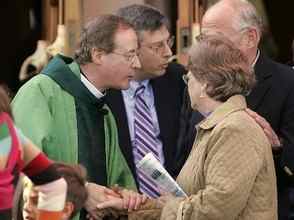
As the parish changes, there’s always something new to consider.
Dan R. Ebner, Servant Leadership Models for Your Parish (Mahwah and New York: Paulist Press, 2010).
Resources
Pastors and councillors who want to improve their work can benefit from a free online Introduction to Parish Pastoral Councils. It offers an overview of the Church’s teaching about councils, with lectures, quizzes, readings, and reflections. Councillors who take the course individually at home can then discuss what they learned when they reassemble for the next meeting of the council.
One Response to Discussion